
Two hundred notifications a day. Five that matter.
Critical stock warnings arrive alongside routine shipping updates and are read three days late. This filters the routine, escalates the critical, and routes it to the person who can act.
What it costs you now
-
Delayed response on bestsellers.
A stockout warning that sits unread for forty-eight hours is two days of lost sales on a product you had the data to protect.
-
Triage labour.
Five to eight hours a week, usually spread across two people, spent reading notifications to find the few that require action.
-
Fragmented data.
Your warehouse system knows stock is low. Your marketing team finds out when the sold-out badge appears.
How it works
-
Multi-system reading
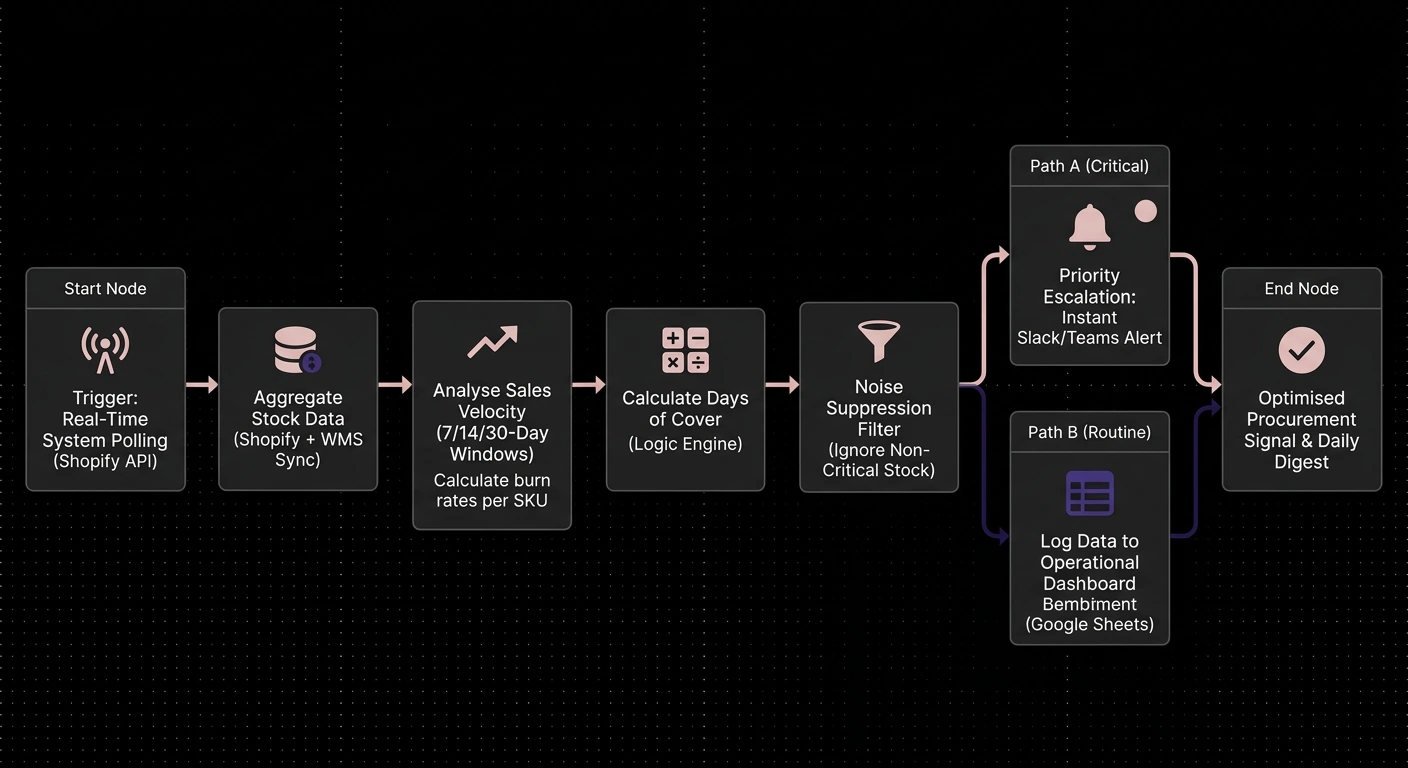
The engine reads live sales from Shopify, physical stock from your 3PL or warehouse system, and open purchase orders from your ERP, resolving them into a single position per SKU.
-
Velocity filtering
Days of cover is calculated on trailing seven, fourteen and thirty-day averages. Raw stock levels are ignored — low stock on a product selling nothing is not an alert.
-
Escalation logic
Where days of cover falls below supplier lead time plus a buffer, the item escalates. Where stock is low but velocity is zero, it is archived silently.
-
Routing
Critical alerts bypass general channels and go directly to the named stakeholder, with the action available in the message. If an alert is not acknowledged within a set window, it escalates to the next person.
What it is worth
Two components, stated separately because they are different kinds of value.
Triage labour: £7,300 to £11,600 a year. Two people spending a combined five to eight hours weekly at £28 loaded hourly cost.
Avoided stockout duration: around £32,000 a year. Assuming faster escalation removes a day and a half from two stockout events monthly, on a product contributing £900 a day.
Both are modelled from typical inputs and verified against your data before anything is built.
Commercials
- Implementation from £4,500 · Retainer from £500 monthly, twelve months then rolling
- Live in two to three weeks
- Typical payback: three to nine months against total first-year cost
Suited to teams monitoring three or more systems.
How the engagement runs
-
 Diagnosis
We measure your current notification volume, the hours spent on it, and your actual response times.
-
 Scope
Scope
We set thresholds per product category and define who receives which escalation.
-
 Build
Build
We construct the connections between Shopify, your warehouse system and your communication tools.
-
 Handover
A week of live monitoring to tune the filters, because the first configuration is never quite right.
Questions
Does this replace Shopify's built-in alerts?
It supersedes them. Most clients switch the native notifications off entirely and rely on a single filtered source.
Which channels do you support?
Slack, Microsoft Teams, WhatsApp, SMS and email.
Can we set tighter rules for priority products?
Yes. Priority SKUs can carry their own thresholds and their own escalation path.
Does it handle multiple 3PLs?
Yes. It aggregates across every connected fulfilment partner.
What if an alert is not acknowledged?
It escalates. A common configuration notifies the operations lead if an alert is unread after two hours.
How is days of cover calculated?
Trailing seven, fourteen and thirty-day sales velocity per SKU, weighted so that recent movement carries more influence than older movement.
Can it draft a purchase order?
Yes, where Supplier Order Optimisation is also in place.
Who is this not for?
Single-system stores with a small catalogue. If your team is not currently losing signal in volume, this solves a problem you do not have.
Establish the figure for your store
The Operational Health Scorecard returns a modelled leakage figure in about four minutes.
No call required.
Take the Operational Health Scorecard